Problem: New
Guarantee: Unavailable
Applicable Industries: Manufacturing Plant, Equipment Mend Retailers, Farms, customized agricultural equipment spare areas
Excess weight (KG): 1 KG
Showroom Location: France
Video clip outgoing-inspection: Supplied
Machinery Test Report: Supplied
Marketing Type: New Item 2571
Kind: solid aluminum agriculture machinery parts for tractors
Use: Tractors
Item Title: Personalized Lower Strain Casting Agriculture Equipment Components
Drawing structure: .stp,.phase,.stl,.pdf,Car CAD,Sound Operate,and many others
Fat: From .05kg to 20kg
Material Quality: ADC12,A380 or as customer’s demands
Surface area concluded: Sandblasting, painting, polishing,powder coating,ED-coating
Major goods: Consumption Manifold series,Cylinder Head series,bracket,housing
Certification: ISO9001 of solid aluminum agriculture equipment areas for tractors
Shipping time: For sample:about forty Times
Support: Custom made metallic areas based mostly on customer’s drawing
Packaging Particulars: Custom made Agriculture Farm Die Casting Aluminum Alloy Tractor Spare Areas: Inner Packing: Strong & water-resistant plastic massive is packed inside of, to keep the merchandise in secure condition.Or as customer requests. Outer Packing: Multilayer wooden box with strong bandages, utilized for standard export bundle. Or personalized as for each customer’s demands.
Port: FOB ZheJiang , or as customers request
Firm Profile SINCERITY Top quality COMPETENCEGeneral Items Application /Services Region:
Custom Steel components for motor vehicle, agriculture machine, building device, transportation products, HK1612 Needle Bearing 16x22x12 Needle Bearings Valve and Pump program. E.g. Engine bracket, truck chassis bracket, gear box , gear housing , equipment go over, shaft, spline shaft , pulley, flange, connection pipe, pipe, hydraulic valve, valve housing ,Fitting , flange, wheel, flywheel, oil pump housing, starter housing, coolant pump housing, transmission shaft , transmission gear, sprocket, chains and many others.
Merchandise Description
| Product Title | Custom made Low Stress Casting Agriculture Machinery Areas Die Casting Aluminum Alloy Tractor Spare Areas | ||||||
| Primary blank Process for forged aluminum | Die Casting, automobile ball bearings 6571 2rs zz rodamientos deep groove ball bearings provider Permanent Molding /Gravity Casting, Minimal Force Casting, Large Strain Casting/Sand Casting, Extrusion Casting and so on. | ||||||
| Blanks Tolerance -Casting Tolerance | CT4-6 for Everlasting Molding, Die Casting. CT 9-11 for Sand Casting | ||||||
| Relevant Substance for Aluminum casting | A356./ZL101,GAlSi7Mg (3.2371.sixty one)/AlSi7Mg/, A-S7G, Al Si Alloy, Al Cu Alloy ZL201 Al Mg Alloy ZL301,ZL302, Al Zn Alloy ZL401Zn Alloy Zamak 3, Zamak 5, Zamak 7, Zamak 2, Or according to consumer demands | ||||||
| Casting Blank Size /Proportions | two mm-1500mm / .08inch-60inch , or in accordance to consumer demands | ||||||
| Applicable Machining Procedure | CNC Machining/ Lathing/ Milling/ Turning/ Uninteresting/ Drilling/ Tapping/ Broaching/Reaming /Grinding/Honing and and so on. | ||||||
| Machining Tolerance | From .005mm-.01mm-.1mm | ||||||
| Machined Surface area Quality | Ra .8-Ra3.2 in accordance to customer requirement | ||||||
| Applicable Heat Therapy | T5~T6 | ||||||
| Applicable End Surface Treatment method | Shot/sand blast, polishing, Primer Portray , Powder coating, ED- Coating, End Painting, Anodize (White or Black Coloration), as buyers request. | ||||||
| MOQ per batch | For casting parts: 100pcs For Machining areas: 50pcs | ||||||
| Lead Time | For tooling & sample: about forty times for agriculture equipment parts casting | ||||||
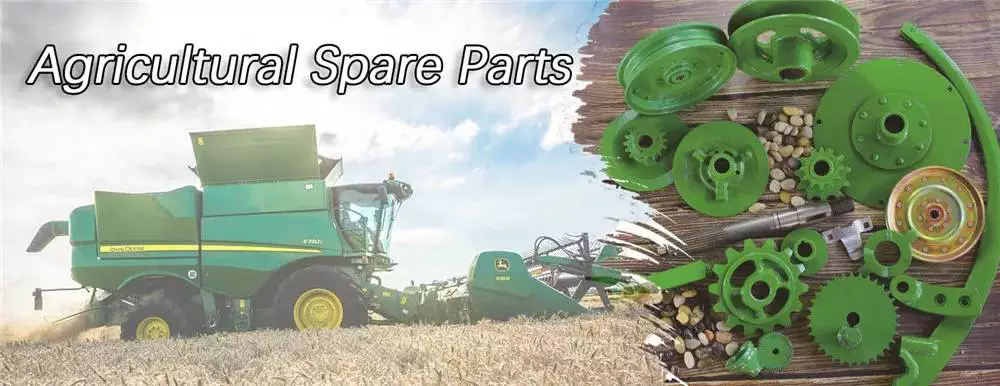
Types of agricultural parts
Agricultural parts can be divided into different categories. These components include tractors, moldboard plows, whips and sickles. Some of the different types of agricultural ingredients are listed below. Each of these parts is important for different types of farming. It is important to know the purpose of each and what it does. If you are a farmer or plan to become a farmer, these parts are critical to your operation.
Tractor
The first tractor appeared in the 1920s. Ford and International Harvester were among the first companies to produce farm tractors, but the industry has grown rapidly. By the 1920s, hundreds of companies were producing farm tractors. The agricultural depression of the 1930s forced many of these companies out of business. By the 1930s, only seven companies were major players in the tractor business. Ford produced the largest number of wheeled tractors in the United States between 1930 and 1955.
Some tractors are equipped with various accessories to enhance their performance. These specialized agricultural components are used for a variety of tasks. These include tillage, harvesting, planting and material handling. Tractors vary in horsepower, lift capacity, control and capabilities. Some models also have device mounting options. The downside of this is that if you need to use the tractor for other purposes, you will have to use additional attachments that can damage the tractor.
Modern tractors have a clutch pedal on the gear lever. This allows you to shift quickly without pedaling. Other tractors have a throttle speed button that improves hydraulic flow to the implement. However, the most important component of a tractor is the engine. Tractors must be driven safely because even minor accidents can cause serious damage to farm equipment. While there are many tractors that can operate without these parts, you can find the right tractor for your job.
Shared plows
One of the many uses of shared plows as part of agriculture is to increase the amount of soil in a field. This plow effectively removes compacted soil and lifts weed roots. According to the University of Nebraska-Lincoln Institute for Agriculture and Natural Resources, plowshares are best used in the fall, when weeds are less active and the soil is more fertile.
The basic plowshare can be adjusted by raising or lowering the plowshare to suit runners in the furrow. However, this design is not suitable for breaking up the heavier soils of northern Europe. In the 6th century, however, the advent of the wheel made it possible to use larger moldboards, which increased food production and population growth. Today, farmers in North America have access to a wide variety of moldboard plows.
Agricultural moldboard plows come in two basic styles, horse-drawn or tractor-style. Horse-drawn models have one bottom, while tractor-pulled moldboard plows have 1 to 14 hydraulically raised bottoms. Other variants include intermediate breakers and twin moldboard plows. Agricultural moldboard plows are often used in the Midwest and elsewhere.
Grass
Grass is used for mowing. The blade is double edged and bolted to the wooden handle. Steel blades are tempered and braced for strength and durability. The blade can be sharpened if necessary. The straw whip is 30 inches long, which can be a good or a bad thing depending on the user’s height. Blades can be sharpened with sandpaper or a file.
The traditional straw whip 32 includes a rear panel and horizontal shelves. It also features a hollow handle with an adapter at the proximal end and a carrying handle at the distal end. The first cable goes to the power supply and goes through the case and handle. After pulling the cable taut, the straw will be firmly attached to the small holder 8.
The suction tube 32 is connected to an electrical connection 47 that powers the device. A battery pack is provided for use away from the tractor. It is a plastic or metal box and consists of two parts: a rechargeable battery 67 and a female electrical plug 68. The switch locks in the open position to prevent accidental use. The switch is also equipped with a safety lock button. These two components work together to operate the straw.
Scythe
Although it is generally believed that the scythe was first developed in Roman times, its actual development may be earlier. Pliny mentioned two different types of sickles, Gallic and Roman. The Gallic sickle was the longer of the two and was made of mild steel, while the Roman sickle was made of harder, higher carbon steel.
In the past, people cut wheat by hand with a sickle. They replaced scythes and bagging hooks, which required users to bend over to harvest crops. Although they have largely been replaced by tractor machinery, scythes are still used today in parts of Asia and Europe. The sickle can also reach awkward corners, making it more useful in certain types of cuts.
The sickle belt stretches from Europe to the Middle East and the Midwest of the United States and Canada. It also spans most of Russia, the Middle East and North Africa. In the 19th century, Austrian sickle makers dominated the sickle industry. They produced millions of sickles, some dating back to the 1500s. Some of them were exported to India and the former Soviet Union.
Brushcutter
Brushcutters are powerful agricultural tools used primarily for felling and trimming vegetation. These parts are often multifunctional, and some models are even capable of maintaining road edges and ditches. Some models can even trim branches from certain types of trees. Before you buy your own brush cutter, be sure to read the manual carefully and follow the safety rules. For your own safety and the safety of others, please wear a hard hat, eye and hearing protection, padded gloves, long pants, and boots, and keep young children away from work areas.
Brushcutters are usually attached to the tractor via a 3-point linkage system, with the exception of high reach models that are attached to the tractor via fixed stirrups. Additionally, brush cutters often have a balancing mass located opposite the tractor. These agricultural components are complicated to install, but once installed, they remain coupled to the tractor. A brush cutter is a critical piece of equipment on any tractor.
Most brushcutters use hydraulic engines. The power is transmitted mechanically through a PTO (power take-over) mechanism or a cardan shaft, which turns a hydraulic pump. This pump draws hydraulic oil from a special tank and then sends it through a series of distributors to move the arm and the working organ. As a result, the power of the brush cutter is transferred from the tractor to the working organ by a hydraulic engine.
Transplanters
Transplanters for agricultural parts are equipment used to plant seedlings into soil. These machines are used in greenhouses and open fields to increase productivity, yield, and the success of harvesting transplanted crops. Transplanters are typically made of steel and are designed to fit seedlings of all shapes and sizes. Buying a used transplanter is a good idea as long as the working parts are in good condition. When considering a used model, you should inspect it for cracks or corrosion and broken parts.
A mechanical transplanter works faster than hand transplanting, but it becomes slower as your quads and back start hurting. Water-wheel transplanters have become popular in recent years. By automatically delivering water into the holes where the transplants are set, water is delivered to the root system without the need for manual intervention. Moreover, water-wheel transplanters save time on watering. John Good, a farmer who uses a water-wheel transplanter, says that speed is no different between a mechanical transplanter and a water-wheel one.
Cultivatorsw
The basic purpose of cultivators is to turn soil and plant matter into a workable form for the crops. Cultivators are used by both large and small farmers. Cultivators for small farming operations are usually self-propelled, but may be drawn behind a tractor. Two-wheel cultivators are typically fixed and powered by couplings, while four-wheel cultivators are attached via a three-point hitch and operated by power take-off. Some cultivators are still drawn behind a draft animal, and the methods are still used in many developing countries.
Cultivators are used in farming to break up soil around a crop. There are three different kinds of cultivators: row crop cultivators, disc cultivators, and power cultivators. Row crop cultivators are used to break up soil before planting, while harrows are used to prepare the soil for planting. In both cases, cultivators are used to disturb the soil consistently throughout the working width. In general, cultivating soil improves aeration and disrupts photosynthesis. Moreover, it can decrease water ponding time after heavy rainfall.
Cultivators are important parts of agricultural machinery. They aerate soil, prepare the seedbed, and kill weeds. By disrupting the soil, cultivators are used to evenly distribute chemical applications. Among them, glyphosate is the most common and widely used weed killer. It is safe for farmers to use, and it effectively eliminates most weeds in a single application.


editor by czh 2023-07-03