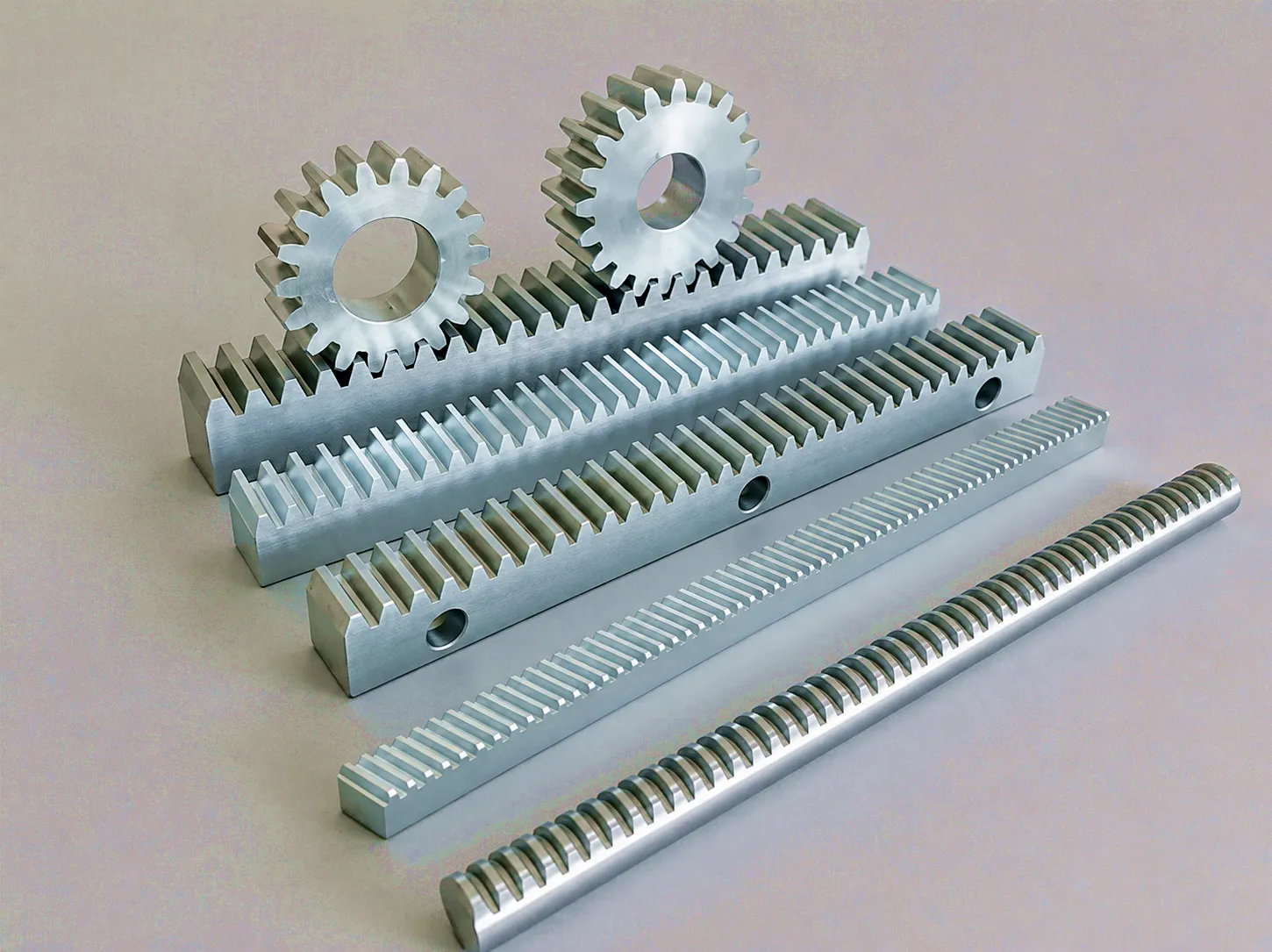
How Gear Racks Are Made: Grinding vs Milling Explained
Precision Grinding: The High-Accuracy Route
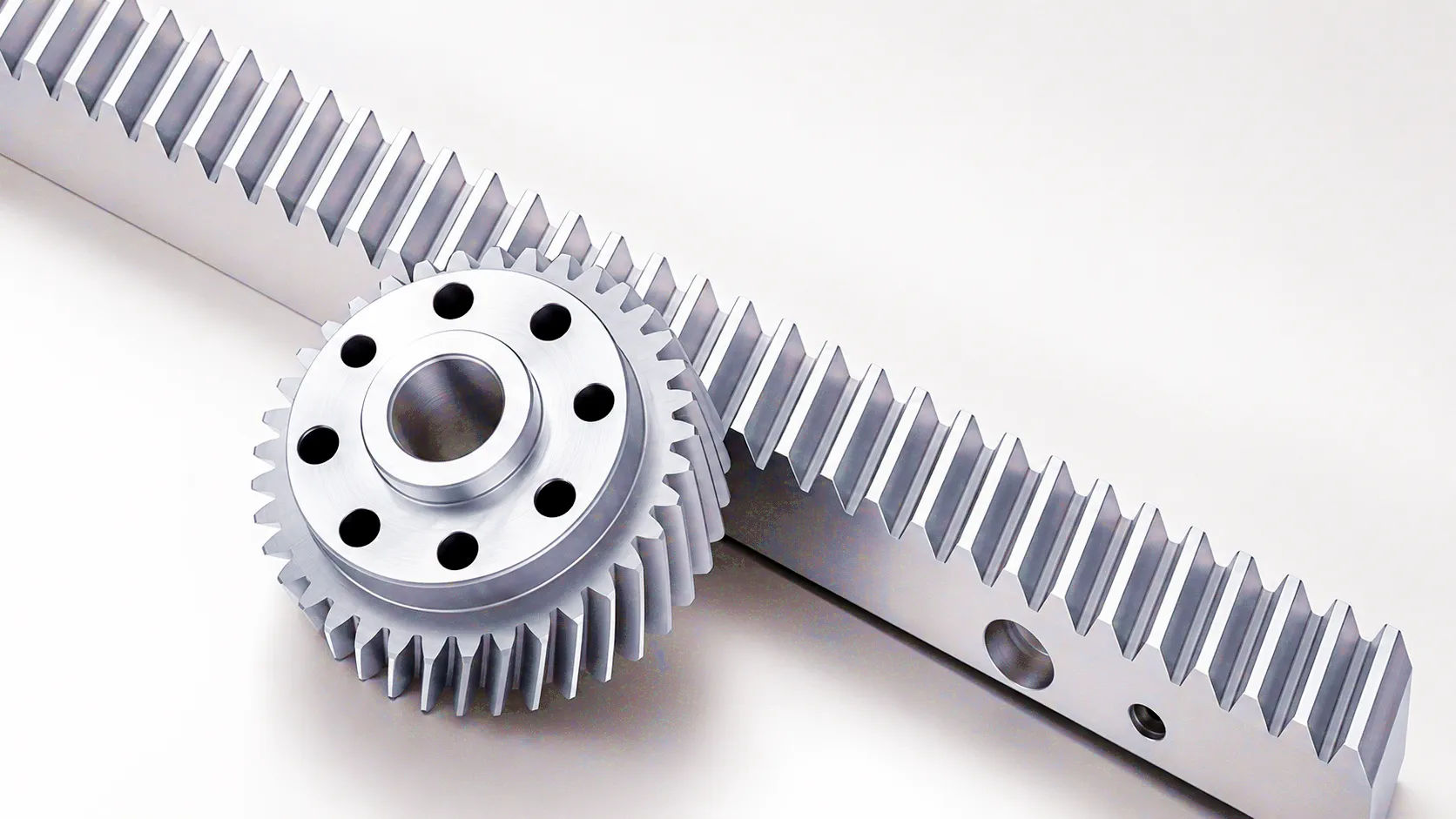
Precision grinding of gear rack tooth profiles begins after an initial milling or hobbing stage produces a near-net-shape blank. The ground gear rack then passes through a profile grinding or form grinding operation using vitrified CBN or aluminium oxide wheels dressed to exact involute geometry. The abrasive wheel removes only a controlled layer of material — typically 0.05 mm to 0.15 mm per flank — generating a tooth surface with roughness values of Ra 0.4 µm or better. This is not simply a finishing pass. The grinding cycle corrects cumulative pitch error, tooth profile deviation, and helix angle error simultaneously, achieving accuracy grades as tight as DIN 4 or even DIN 3 on specialist gear racks intended for high-end measurement systems and semiconductor equipment.
The thermal management during gear rack grinding is critical. Coolant flow rates, wheel speed, and workpiece feed are carefully balanced to prevent metallurgical burn — a phenomenon that would soften the case-hardened surface layer and introduce tensile residual stresses. Leading manufacturers use in-process gauging to monitor pitch error in real time, feeding corrections back into the CNC grinding controller. The result is a gear rack where the tooth-to-tooth pitch error across any 300 mm span stays within ±3 µm, and cumulative pitch error across the full rack length is tightly controlled.
Milled and Hobbed Racks: Speed and Economy
A milled gear rack is produced by a rotary form cutter or hob traversing along the workpiece, cutting the tooth gaps in sequence. Gear hobbing is by far the more common industrial process — the hob’s helical cutting edges generate the involute tooth form through a generating motion, producing consistent geometry at high feed rates. A modern CNC hobbing machine can cut a standard gear rack in a fraction of the time a grinding operation takes, which explains why milled gear racks dominate the middle and lower segments of the market. The tooth surface left by hobbing typically exhibits Ra values between 1.6 µm and 3.2 µm, which is perfectly adequate for a wide range of conveying, gantry crane, and general-purpose automation tasks.
What a milled gear rack cannot readily achieve is the tight pitch accuracy a ground gear rack delivers. Thermal growth in the cutting tool, runout in the hob arbor, and workpiece fixturing compliance all contribute to pitch errors that, across a long gear rack, may accumulate to 15–30 µm per 300 mm. For a conveyor system or an agricultural feeding mechanism, that level of error is irrelevant. For a CNC gantry router where the tool-path accuracy is measured in microns, it becomes the limiting factor in finished part quality.
Material Science Behind High-Performance Gear Racks
20CrMnTi — The Workhorse Alloy
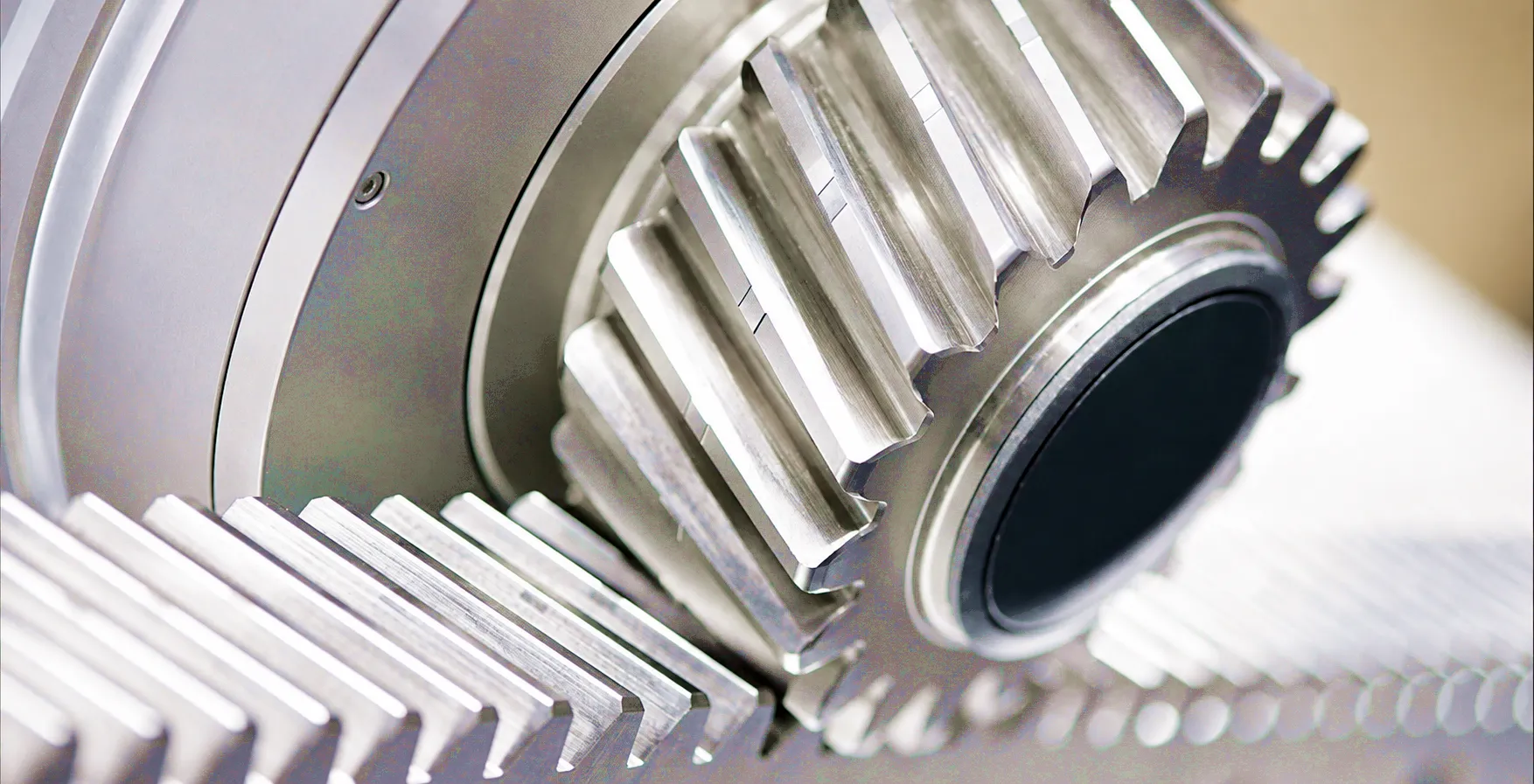
The case-carburising steel 20CrMnTi is the go-to material for gear racks in demanding industrial drives. Its chromium-manganese-titanium alloying gives a tough, ductile core with a through-hardened surface after carburising and quenching, reaching HRC 58–62 at the tooth flank. This combination resists the Hertzian contact fatigue that destroys softer gear rack teeth under cyclic loading. Manufacturers in Sheffield’s precision engineering sector frequently specify this grade for ground gear racks used in CNC machining centre axes, where the combination of high surface hardness and crack-resistant core is essential for service lives measured in decades, not years.
42CrMo4 — Induction Hardening Candidate
42CrMo4 (BS EN 10083-3 designation) is a chromium-molybdenum medium-carbon steel ideally suited to induction hardening. Induction hardening heats only the tooth surface and immediate sub-surface material to austenitising temperature using high-frequency eddy currents, then quenches rapidly. This produces a hardened case of HRC 52–58 while leaving the bulk of the gear rack body in a tougher, more machinable condition. Long gear rack lengths — common in automated warehousing and gantry systems — benefit from this approach because distortion is minimised: only the tooth zone is heated, so the gear rack body remains dimensionally stable. Ever Power routinely supplies induction-hardened gear rack sections in 42CrMo4 to UK OEMs building automated storage and retrieval systems (AS/RS).
C45 Steel and Stainless Options
C45 medium-carbon steel is frequently chosen for standard milled gear racks where budget is a primary constraint and duty cycles are moderate. Its machinability is excellent, and surface hardness in the HRC 40–48 range is achievable through flame hardening. For applications where chemical exposure or washdown procedures are routine — food processing lines in Leeds, marine engineering facilities on the Tyne, or pharmaceutical manufacturing in the Cambridge life sciences belt — gear racks in 304 or 316 stainless steel provide the corrosion resistance no carbon steel treatment can match long-term. Surface treatments such as hard chrome plating, black oxide, and zinc-nickel electroplating extend service life across all steel grades by adding a sacrificial corrosion barrier without meaningfully altering the tooth geometry.
Performance Advantages: Ground Gear Racks vs Milled Gear Racks
The performance gap between a ground gear rack and a milled gear rack is not marketing rhetoric — it is measurable at the machine level. Understanding where each type delivers genuine value requires looking at seven technical dimensions that buyers consistently cite when troubleshooting drive system problems.
Positioning Accuracy
Ground gear racks achieve positioning repeatability of ±0.01 mm or better across full travel. Milled gear racks typically allow ±0.05–0.1 mm, sufficient for general automation but unsuitable for precision machining or measurement axes.
Noise and Vibration
The smoother tooth flanks of a ground gear rack reduce gear mesh excitation significantly. In high-speed gantry applications, this translates to 6–10 dB lower radiated noise and reduced structural vibration that would otherwise limit servo bandwidth and dynamic positioning performance.
Load Capacity and Fatigue Life
The compressive residual stresses introduced at the tooth flanks during grinding boost contact fatigue resistance. Ground gear racks in 20CrMnTi can sustain Hertzian pressures exceeding 1600 MPa reliably. Milled racks in C45, even after flame hardening, are typically rated to 900–1100 MPa, limiting their use in heavy-duty linear drives.
Total Cost of Ownership
The acquisition price of a ground gear rack is 2–4 times that of a comparable milled gear rack. However, in precision applications, the reduced maintenance intervals, longer service life, and lower reject rates in machined components routinely deliver a lower total cost over a five-year machine life — a calculation UK plant engineers are increasingly required to present to procurement boards.
Backlash Control
A zero backlash rack system combining a precision ground gear rack with a preloaded split-pinion drive can achieve effective backlash below 3 µm — critical for laser cutting heads, waterjet tables, and high-precision pick-and-place units. Milled gear racks, even with careful pinion sizing, rarely achieve consistent backlash below 20–30 µm.
Surface Finish & Lubrication Retention
The micro-valleys left by the grinding wheel on a ground gear rack tooth flank act as micro-reservoirs for lubricant, improving film retention under high-speed conditions. This is particularly relevant for continuous-duty gear rack drives operating at pinion pitch-line velocities above 2 m/s, where lubricant film breakdown is the primary failure mode.
Product Technical and Performance Parameters
The following table provides a direct performance comparison between precision ground gear racks and standard milled gear racks across the parameters most critical to UK OEM buyers and plant engineers.
| Parameter | Precision Ground Gear Rack | Standard Milled Gear Rack |
|---|---|---|
| Module Range | M1 – M10 | M1 – M20 |
| Accuracy Grade (DIN 3962) | DIN 3 – DIN 6 | DIN 7 – DIN 10 |
| Surface Roughness Ra | Ra 0.2 – 0.8 µm | Ra 1.6 – 3.2 µm |
| Pitch Error per 300 mm | ±3 – ±6 µm | ±15 – ±30 µm |
| Tooth Flank Hardness | HRC 58 – 62 | HRC 40 – 52 |
| Max Standard Length | 3000 mm (joinable) | 6000 mm |
| Typical Tooth Profile | Helical (14.5° or 20° PA) | Straight or Helical |
| Material Options | 20CrMnTi, 42CrMo4, 17CrNiMo6 | C45, 40Cr, Cast Iron, PA6 |
| Max Allowable Tangential Force (M4 example) | Up to 28 kN | Up to 14 kN |
| Typical Relative Price Index | 2.5× – 4× base | 1× base |
Industrial Application Scenarios Across UK Manufacturing
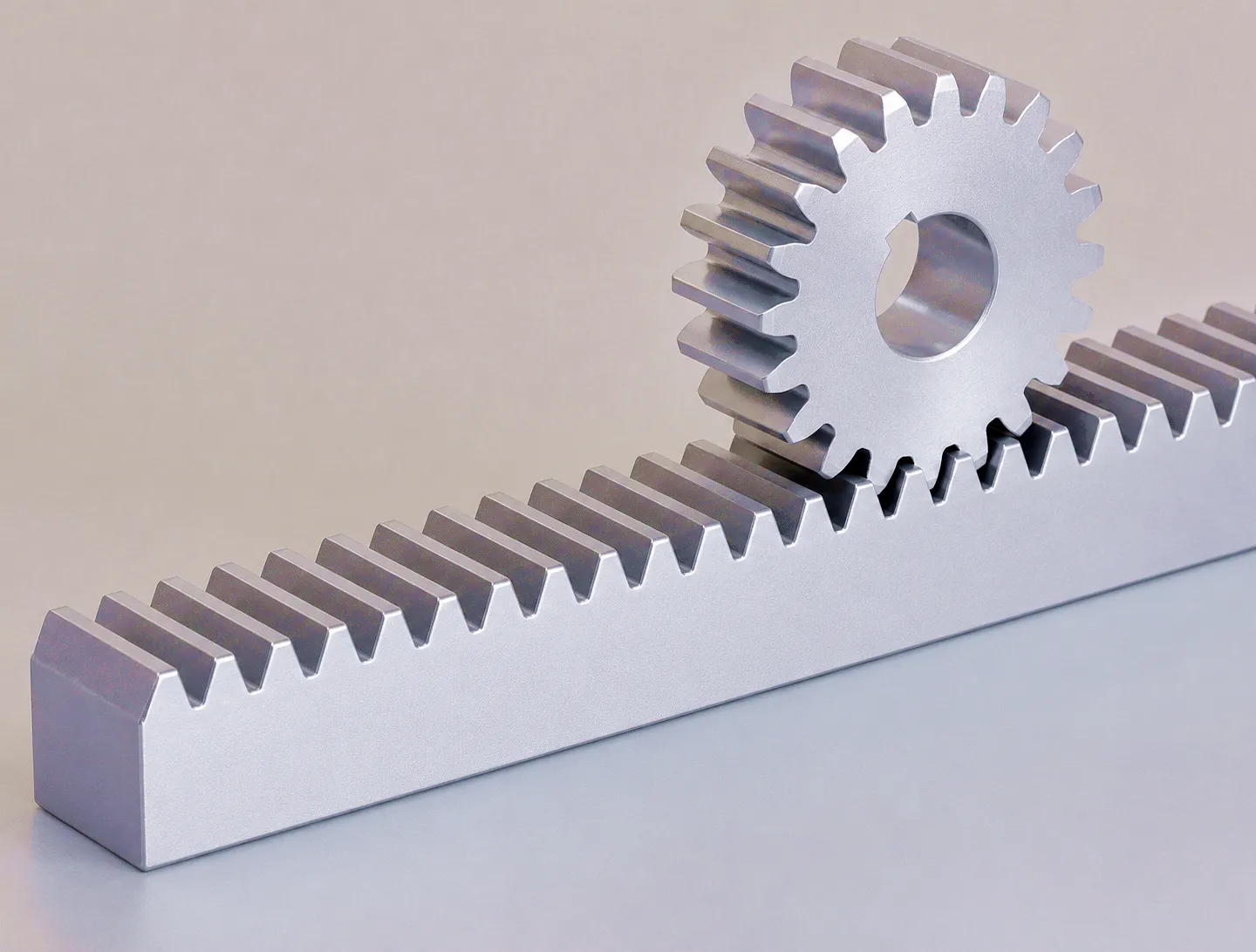
The gear rack serves as the fundamental linear drive element across an extraordinarily diverse range of UK industries. Matching the right gear rack specification to each application environment is where engineering judgement and product knowledge intersect.
Birmingham’s West Midlands manufacturing cluster hosts one of the UK’s densest concentrations of CNC machining cells, supplying everything from automotive structural components to aerospace brackets. Five-axis machining centres in this region routinely use precision ground gear racks on their linear axes, typically in module M4 or M6 with helical tooth profiles and DIN 5 accuracy class. The helical ground gear rack — as found in our precision ground helical rack range — reduces the tangential force impulse at each tooth engagement, lowering vibration transmitted into the spindle and dramatically improving surface finish quality on machined components. Machine tool builders sourcing gear rack for new machining centre builds or retrofit projects in the Birmingham corridor consistently specify ground accuracy to protect their process capability indices.
Sheffield’s Advanced Manufacturing Park brings together some of the UK’s most technically demanding machining and surface finishing operations for aerospace OEMs including Rolls-Royce, Boeing suppliers, and Airbus tier-one partners. Coordinating measuring machines (CMMs) in these facilities use ground gear racks on their bridge axes, where any pitch error directly degrades measurement uncertainty — an unacceptable outcome when certifying turbine blade profiles to AS9100 tolerances. Similarly, horizontal broaching machines and precision jig-boring equipment used to finish titanium and nickel-alloy aerospace structural parts rely on ground gear racks to maintain positional accuracy throughout long cutting strokes. The combination of high surface hardness, tight pitch control, and reliable lubrication retention makes a ground gear rack the only viable choice in this environment.
The Leeds-Bradford corridor has long served as a hub for UK food-grade packaging machinery design and manufacture. Milled gear racks in stainless steel or anodised aluminium serve the majority of packaging line axis requirements, where speeds are moderate and positional accuracy in the ±0.05 mm range is entirely adequate for carton erection, film tracking, and labelling head positioning. Cycle rates are the dominant design driver here — gear racks must withstand tens of millions of reversal cycles without detectable wear growth. Properly flame-hardened C45 gear racks running against cast-iron pinions in splash-lubricated gearboxes have demonstrated service lives exceeding twelve years on major confectionery line builds in this region. For washdown-intensive fresh produce lines, stainless 304 milled gear racks with IP65-rated covers are the established solution.
Derby’s position as the UK’s railway engineering capital — home to Alstom, Bombardier (now Alstom), and numerous rail maintenance and overhaul facilities — generates consistent demand for large-module gear racks in rail-mounted wheel lathe underframes and overhead crane systems used to handle bogie frames and power cars. These applications call for milled gear racks in module M8 to M16, manufactured from 42CrMo4 and through-hardened, offering the combination of high load capacity and ease of field replacement that maintenance environments demand. Doncaster’s rail freight depot cluster similarly uses gear racks in wagon lifting and traverser systems, where the ability to source replacement gear rack sections without long lead times is as important as the specification itself.
The life sciences manufacturing corridor stretching between Cambridge and Oxford has grown rapidly into one of Europe’s leading clusters for precision medical device and diagnostic equipment production. Linear positioning systems within laboratory automation platforms, confocal microscope stages, and robotic dispensing systems commonly use ground gear racks in small modules (M1 to M2) with ultra-fine pitch control and very low backlash. The specific requirements of medical device manufacturing also place emphasis on cleanroom-compatible materials and surface coatings — electroless nickel-plated gear racks are common, providing a corrosion-resistant, low-outgassing surface compatible with ISO Class 6 environments.
Wind turbine blade pitch systems represent one of the more technically demanding gear rack applications in the UK renewable energy sector. Each blade pitch axis uses a gear rack and pinion drive — typically module M14 to M20 in high-strength 42CrMo4 with induction-hardened tooth flanks — to control blade angle under highly dynamic loading from wind gusts. The gear rack operates in a sealed, grease-lubricated environment that must function reliably from -30°C winter temperatures in the Scottish Highlands and North Sea offshore installations, through to +50°C nacelle temperatures during summer peak generation. Gear rack fatigue rating under variable amplitude loading is the primary design criterion, and manufacturers supplying the UK wind energy sector must provide full material traceability and batch testing documentation to meet the BS EN ISO 6336 fatigue life verification requirements adopted by leading turbine OEMs.
Customer Success Story: Sheffield Aerospace Precision Engineering
Sheffield, South Yorkshire · Aerospace Structural Components
Eliminating Cumulative Pitch Error on a Five-Axis Gantry Router Serving an Airbus Tier-One Supplier
A precision engineering contractor based in Sheffield’s Sheaf Valley manufacturing district was supplying machined aluminium structural panels to an Airbus tier-one composites integrator. Their five-axis gantry router — a 12-metre travel machine used to trim, drill, and route composite panels — had been fitted with milled gear racks during its original commissioning six years earlier. Over time, accumulated pitch error across the gear rack joints had grown to the point where positional deviations of 60–80 µm were being recorded at inspection, causing rework rates on critical panel cutouts to climb above 4% — an unacceptable figure for an aerospace supply chain operating under AS9100 Rev D certification.
Ever Power’s UK technical team was brought in to conduct a drive system audit. The root cause was clear: the original milled gear rack had accumulated a cumulative pitch error of 94 µm across its 12-metre length, far exceeding the 30 µm maximum that the machine’s servo system could compensate via error mapping. The solution selected was a full gear rack replacement using Ever Power’s precision ground helical rack in 20CrMnTi, module M6, DIN 5 accuracy grade, with butt-joint sections precision-matched at the factory to maintain pitch continuity across joints within ±4 µm. Installation was carried out during a planned four-day maintenance shutdown, with a laser tracker verification run confirming that the completed gear rack installation achieved a cumulative pitch error of 18 µm across the full 12-metre travel — a reduction of more than 80% compared to the worn milled gear rack system.
Six months post-installation, the facility reported a reduction in panel rework rate from 4.1% to 0.3%, recovery of full AS9100 process capability on critical dimensions, and a measurable improvement in servo following error that allowed the machine’s feedrate ceiling to be raised by 15% without violating the dynamic accuracy specification. The total cost of the gear rack replacement, including Ever Power’s on-site technical support, was recovered within seven weeks through reduced scrap and rework costs.
What UK Engineers and Buyers Say About Ever Power Gear Racks
“We replaced milled gear racks on two of our Rottler machining centres with Ever Power’s ground gear rack range. The pitch accuracy on delivery was within 5 µm across 2.5 metres — exactly what the inspection certificate stated. Our CNC programmer had the error mapping file almost blank after calibration. These gear rack sections have now run 18 months without measurable wear growth.”
“I had been sourcing gear rack sections from a European intermediary with lead times of five to eight weeks. Switching to Ever Power cut our delivery time to nine working days for standard sizes, and their custom gear rack — a non-standard module with a modified back height — was with us in four weeks. The documentation package for our AS9100 quality file was comprehensive and required no supplementary requests.”
“Our pick-and-place robotic cell uses Ever Power’s zero backlash gear rack system with a preloaded pinion drive. Before we specified this, our previous gear rack system gave us repeatable positioning of ±0.04 mm — adequate but never comfortable. The Ever Power ground gear rack and split pinion combination brought that to ±0.008 mm verified by laser interferometry. It made a tangible difference to our yield rate on small component assembly.”
Frequently Asked Questions
Questions UK engineers and procurement teams ask most often about gear rack selection, pricing, and supply.
How much does a precision ground gear rack cost, and where can I get a quick quote from a UK supplier?
The price of a precision ground gear rack varies significantly with module, length, material, and accuracy grade. As a general guide, a DIN 5 ground helical gear rack in 20CrMnTi at module M4, 1000 mm length, typically runs 3–5 times the cost of an equivalent milled rack. For an accurate quote tailored to your specific dimensional and tolerance requirements, contacting Ever Power directly at sales@farm-equipment-parts.com gets you a response within one working day, including dimensional confirmation and delivery lead time to your UK location.
What is the difference between a DIN 5 and a DIN 8 gear rack, and which one should I specify for a CNC machining centre in Birmingham?
DIN accuracy grades define the allowable tooth-to-tooth pitch error, profile deviation, and helix angle error of a gear rack, with lower numbers indicating tighter tolerances. A DIN 5 ground gear rack holds pitch error to roughly ±5 µm per 300 mm, while a DIN 8 milled gear rack allows ±20–25 µm over the same span. For a CNC machining centre in Birmingham’s automotive or aerospace supply chain, DIN 5 to DIN 6 is the standard specification. For general automation with positioning tolerance requirements looser than ±0.05 mm, DIN 8 is adequate and significantly more economical.
Which type of gear rack material is best for a stainless steel gear rack used in food-grade packaging lines across the Leeds manufacturing district?
For food-grade packaging environments in Leeds and the wider Yorkshire manufacturing region, austenitic stainless steel — specifically 304 or 316L — is the standard gear rack material choice. Grade 316L provides superior resistance to chloride-based cleaning agents used in wet-area food processing, making it preferable over 304 where NaCl or CIP chemical washdown is routine. Milled stainless gear racks in these grades are available in modules M2 through M8 and can be supplied with electropolished tooth flanks for improved cleanability and reduced bacterial adhesion in direct food-contact proximity zones.
How do I join multiple gear rack sections together on a long gantry system without creating a positioning error at each joint?
Joint management on multi-segment gear rack installations is one of the most common technical challenges on long-travel gantry builds. The correct approach is to order gear rack sections that are factory-matched in pairs — the manufacturer measures and selects sequential sections so that the tooth at the end of one section and the start of the next form a continuous pitch within the specified tolerance. Precision ground gear rack sections joined this way can maintain joint pitch error below ±5 µm. The joint face itself must be precision-machined flat and square, and the mounting surface must be aligned to within 0.02 mm across the full length using a laser tracker or precision straightedge before the gear rack is bolted down.
Where can I find a reliable UK gear rack supplier who can deliver custom lengths and modules within two weeks for an urgent machine rebuild project in Sheffield?
For urgent gear rack supply to Sheffield or any UK location, Ever Power maintains bonded UK stock of commonly specified milled gear rack modules and can expedite ground gear rack production for fast-track machine rebuild requirements. Standard milled gear rack sizes are typically dispatched within 3–5 working days from UK stock. Custom ground gear racks — non-standard modules, modified back heights, or special surface treatments — can be produced in 10–15 working days on a priority basis. Contacting sales@farm-equipment-parts.com with your module, length, accuracy grade, and required delivery date allows our technical team to confirm availability and provide a freight-inclusive price to your Sheffield delivery address promptly.
What lubrication should I use on a precision ground helical gear rack running at high speed on an automated warehousing system in a UK distribution centre?
High-speed helical gear rack drives in automated storage and retrieval systems require a pressure-extreme (EP) gear grease or gear oil applied at a controlled rate to maintain a continuous lubricant film at the pinion-gear rack contact zone. For enclosed distribution centre environments in the UK where ambient temperatures range from approximately 5°C to 25°C, an NLGI Grade 1 or Grade 2 EP grease with a lithium complex thickener and MoS2 additive package provides good film retention across the tooth flank. Automatic progressive lubrication systems timed to pinion engagement cycles are strongly recommended on gear rack drives with pitch-line speeds above 1.5 m/s to prevent the lubricant starvation that accelerates surface fatigue.
When is it worth paying the premium price for a ground gear rack rather than using a less expensive milled gear rack in my industrial application?
The upgrade to a ground gear rack becomes clearly cost-justified when any of the following conditions apply: your machine’s positioning tolerance specification is tighter than ±0.03 mm; your drive operates at high cycle rates where gear mesh noise must be minimised to meet workplace noise regulations; your process generates scrap or rework costs that dwarf the gear rack price differential; or your machine must carry full material traceability documentation for aerospace, medical, or defence customers. When none of these conditions apply — for example, on a heavy-duty gantry crane or a general-purpose conveyor — a good quality milled gear rack in 42CrMo4 with induction-hardened teeth delivers reliable service at a fraction of the cost.
How does induction hardening of a gear rack tooth improve its service life compared to a through-hardened gear rack in heavy-duty UK industrial environments?
Induction hardening concentrates a high-hardness martensitic case — typically HRC 52–58 and 1.5–3 mm deep — specifically at the tooth flank surface, where all the Hertzian contact stress is generated. This leaves the gear rack body core in a tougher, more impact-resistant condition than a through-hardened component, which is brittle at high hardness levels. In heavy-duty UK industrial environments — overhead crane traversers, open-air rack-and-pinion slewing systems, and large-format CNC router beds — the combination of a hard tooth surface resisting contact fatigue with a tough core absorbing shock loads from tool engagement or load impacts delivers significantly better overall durability than either through-hardening or surface flame hardening can achieve for the same gear rack geometry.
Ever Power · Precision Gear Rack Manufacturer · Supplying UK Industry
sales@farm-equipment-parts.com
edit by gzl