How Each Rack Type Works: Tooth Geometry and Engagement Mechanics
Core operating principles compared at the tooth and contact-zone level
Spur Gear Rack — Straight-Cut Teeth
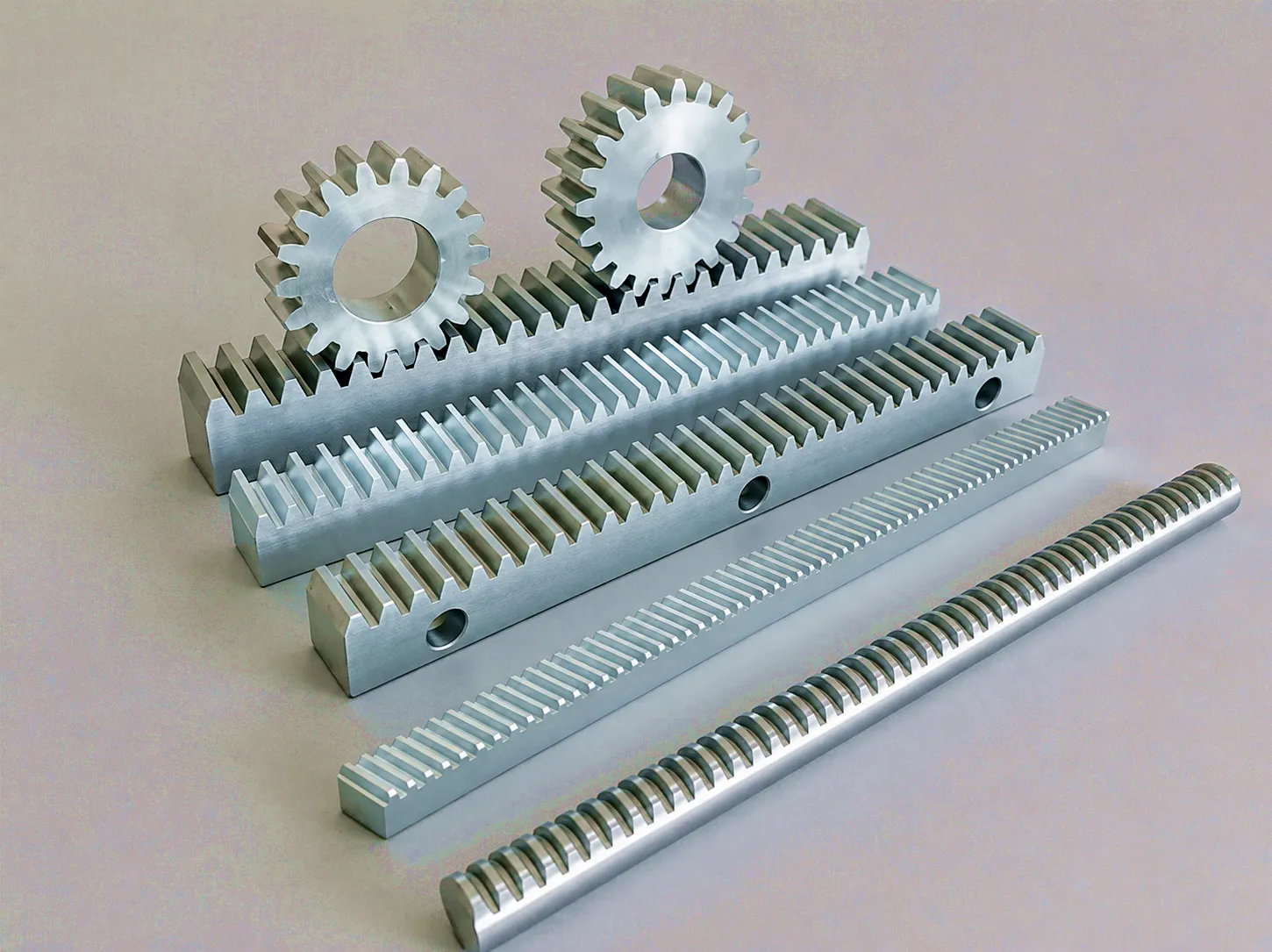
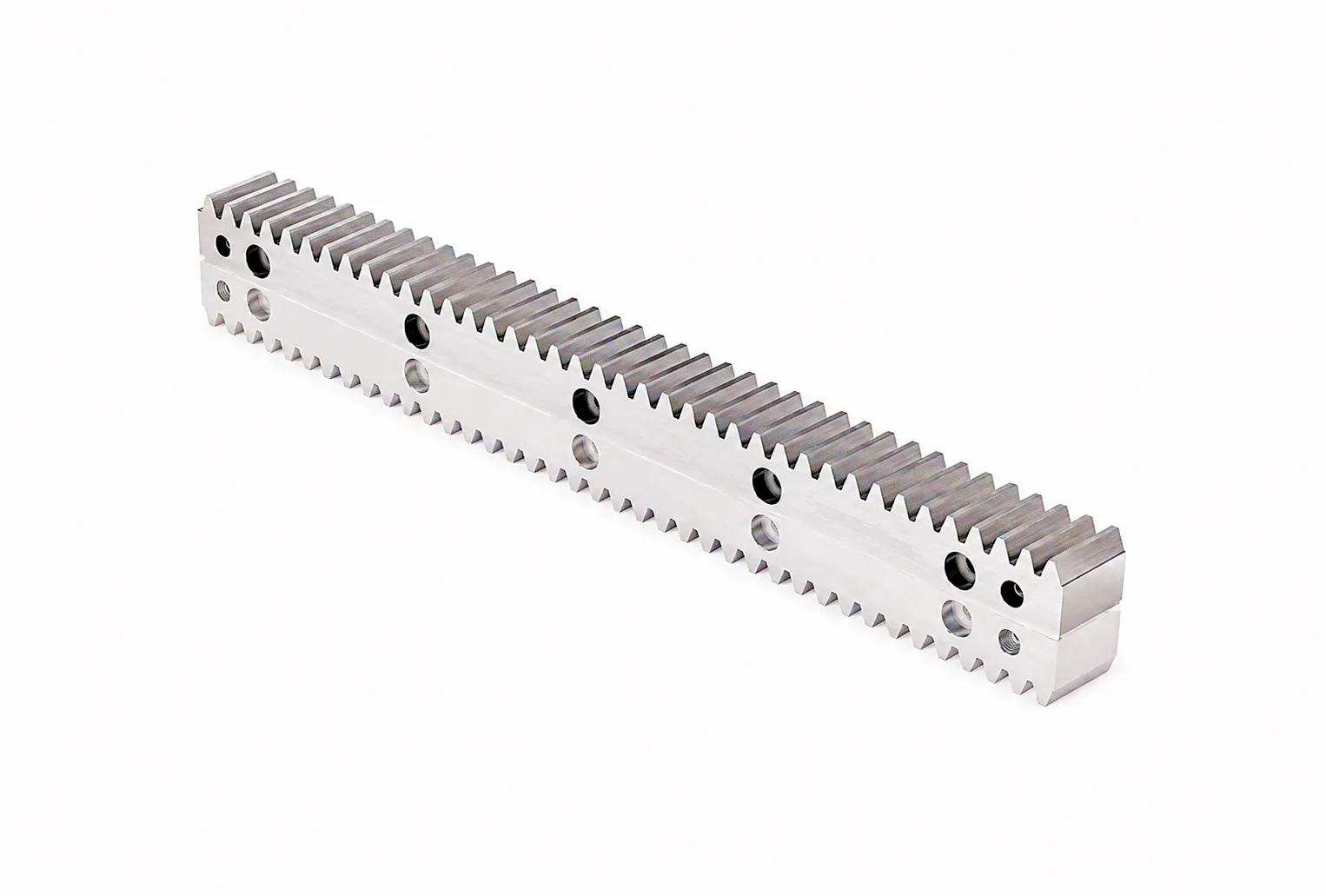
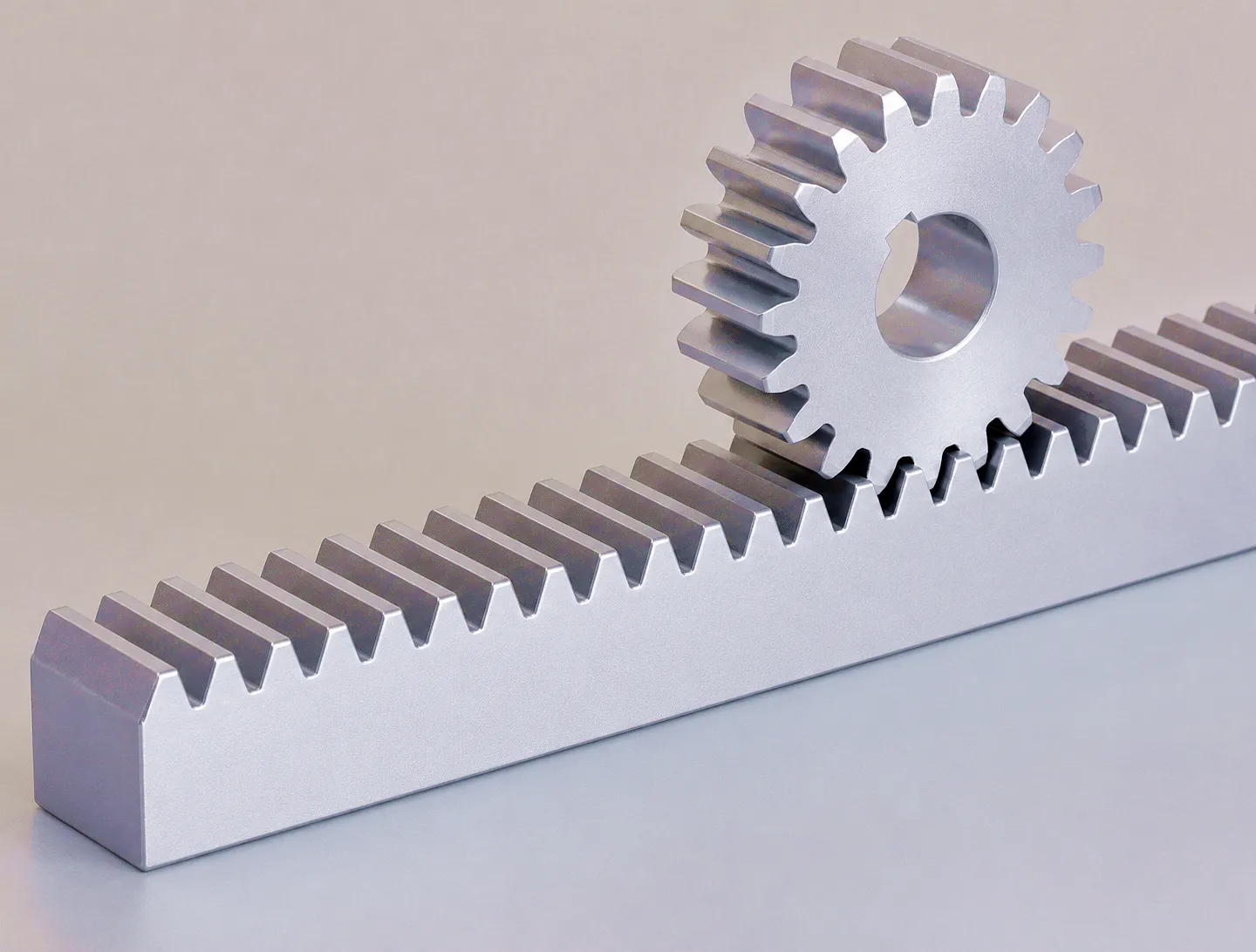
A spur gear rack carries teeth that are oriented parallel to the rack’s longitudinal axis and perpendicular to the direction of travel. When a spur pinion meshes with this rack, contact across the full tooth face width begins and ends simultaneously — an instantaneous, line-contact engagement. This abrupt load transfer produces the characteristic periodic excitation that engineers identify as transmission error. At moderate traverse speeds, typically below 1.5 m/s, this impulse is manageable and the design remains highly cost-effective. The straight tooth flank also simplifies grinding, hobbing and profile inspection, contributing to a lower unit cost per metre when rack lengths are standardised. For machinery in Birmingham’s automotive pressing plants or conveyor indexing systems in logistics hubs around Coventry, a well-specified spur rack with module 2 to module 6 pitch offers robust performance at a price point that suits high-volume procurement budgets. The absence of an axial thrust component simplifies bearing selection for the pinion shaft, which reduces both assembly complexity and the risk of bearing pre-load errors during machine commissioning.
Helical Gear Rack — Angled-Tooth Engagement
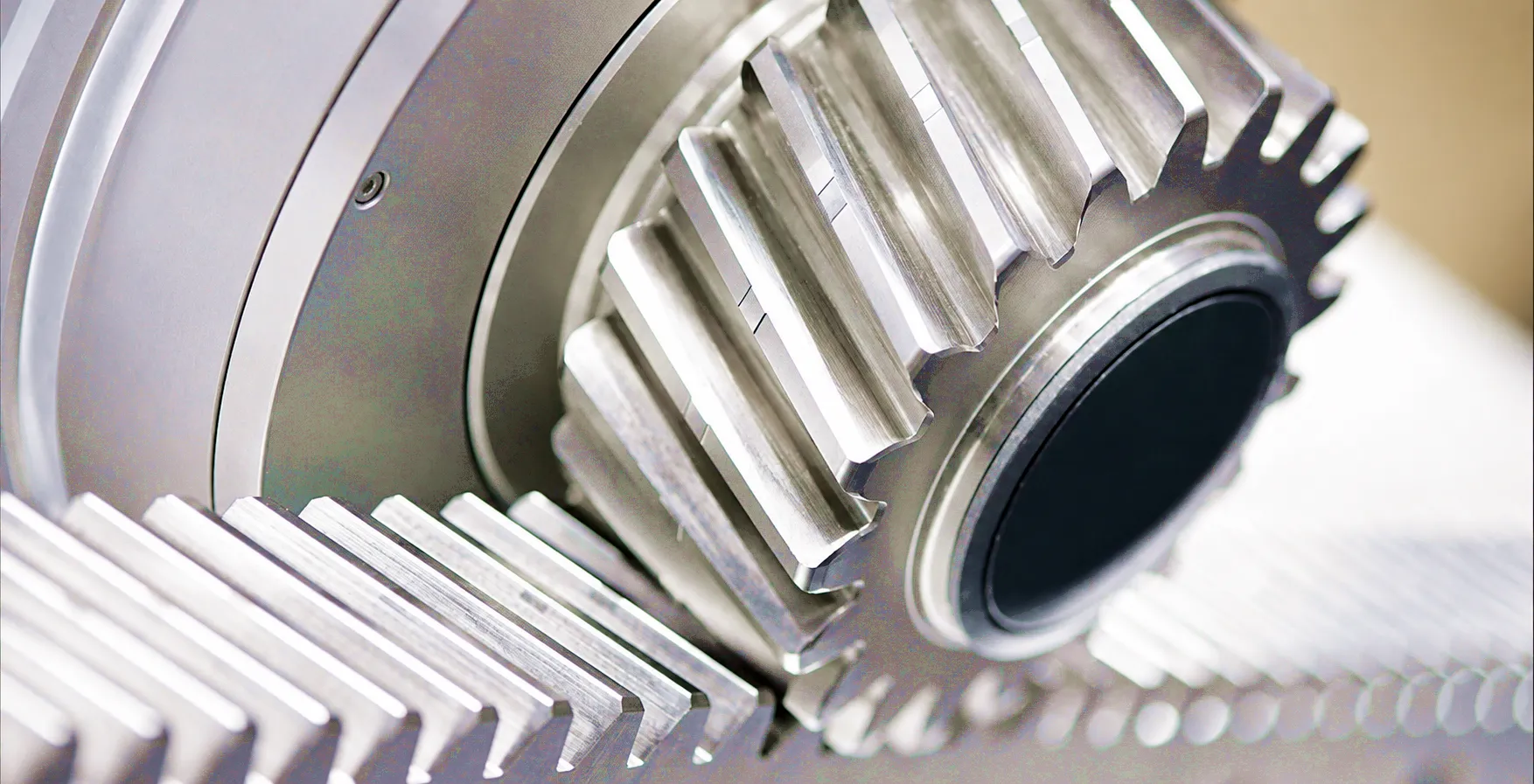
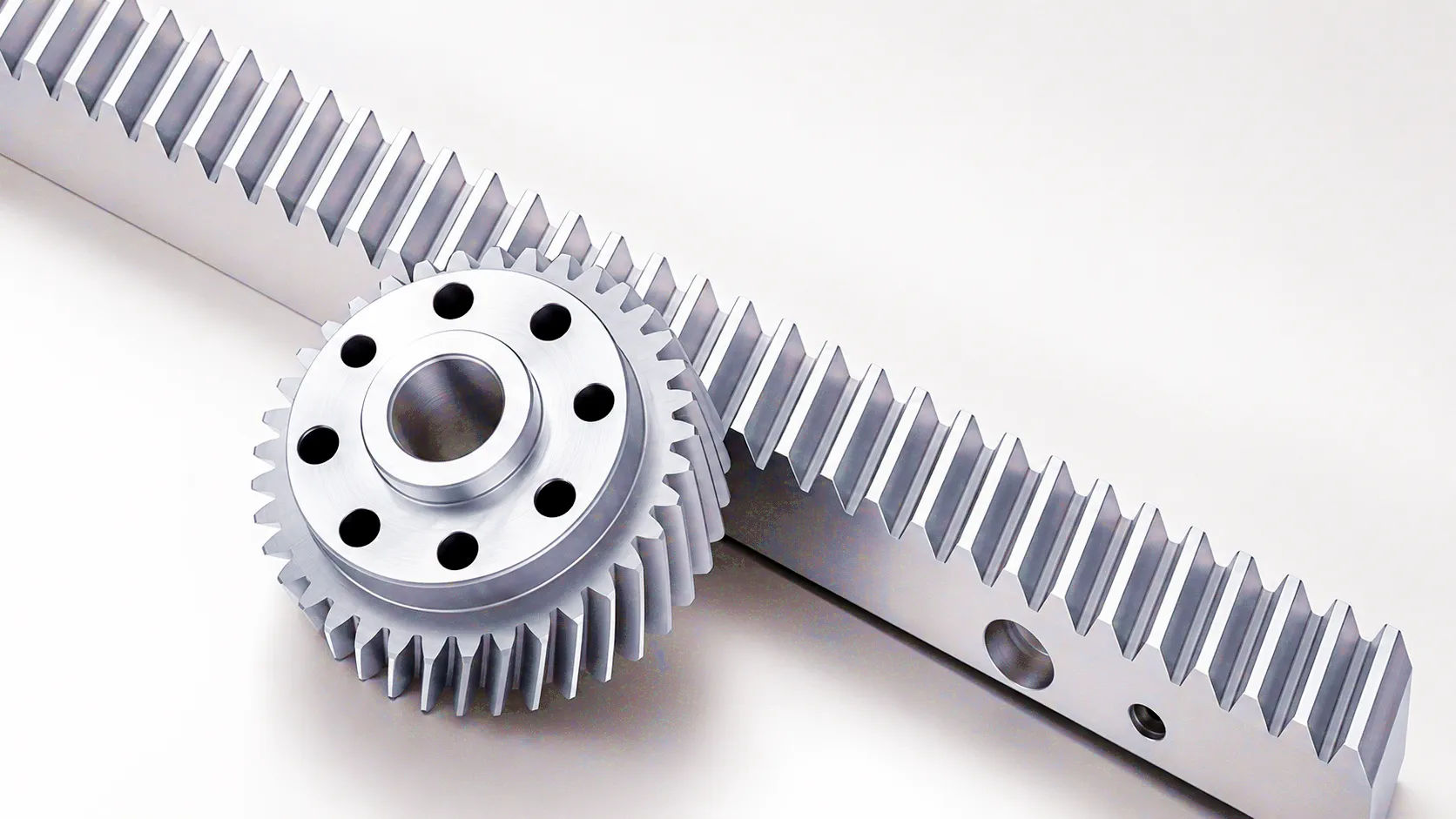
A helical gear rack positions each tooth at a defined helix angle — most commonly between 15° and 25° — relative to the direction of travel. Because the pinion and rack engage progressively along a diagonal contact line rather than instantaneously across the full face width, load is introduced gradually and distributed over a larger tooth area at any given instant. The overlap ratio exceeds 1.0, meaning more than one tooth pair is in contact throughout the meshing cycle. This continuous load sharing eliminates the sharp impulse loading seen in spur engagement and reduces dynamic excitation by a factor that can reach 60–70% in precision ground configurations. The consequence is dramatically lower operating noise — often 8 to 15 dB quieter than an equivalent spur rack system — and markedly superior positional accuracy at high traverse rates. Helical racks are the default choice for five-axis machining centres assembled in Sheffield, gantry-style coordinate measuring machines built in Huddersfield, and high-speed pick-and-place automation deployed across the Greater Manchester electronics manufacturing belt. The trade-off is an axial thrust load on the pinion shaft that must be reacted by angular contact or crossed-roller bearings, adding a small premium to the bearing arrangement.
Core Materials and Surface Engineering for Gear Rack Manufacture
From blank steel selection to final surface treatment — how material science determines service life
C45 Medium Carbon Steel
The industry workhorse for spur and helical racks operating under general industrial loads. C45 steel — corresponding to BS 970 En 8 in UK designation — offers a balanced combination of machinability, surface hardenability and cost. After hobbing or shaping, rack teeth are typically induction hardened to 50–58 HRC at the flank and root, leaving the core at 22–30 HRC to absorb shock loading without brittle fracture. This dual-zone hardness profile is particularly valued by manufacturers supplying linear axes for robotic welding cells in Sunderland and material handling gantries in the East Midlands logistics corridors. Surface roughness after precision grinding typically reaches Ra 0.4 to Ra 0.8 µm, sufficient for rack-and-pinion assemblies targeting DIN 6/7 quality class performance.
42CrMo4 Alloy Steel
When a gear rack must sustain high dynamic loads, elevated tooth bending stress or sustained contact pressures exceeding 1,200 N/mm², alloy steel grades such as 42CrMo4 (BS 970 En 19 equivalent) are selected. The chromium-molybdenum addition refines the martensite structure during quench hardening, producing a tooth surface capable of reaching 58–62 HRC with a deeper hardened case depth of 1.5–3.0 mm — critical for wide-face racks used in heavy-duty milling centres or large-format plasma cutting tables manufactured in Sheffield. Through-hardening followed by precision grinding to DIN quality class 5 or better is achievable with 42CrMo4, and the material’s high fatigue strength makes it the preferred specification for racks operating in duty cycles exceeding 18 hours per day in UK automotive Tier 1 supplier facilities.
Stainless Steel & Specialty Alloys
Food-grade processing machinery installed in Yorkshire’s agricultural produce sector, pharmaceutical packaging lines in Hertfordshire clean rooms, and coastal marine installations in Scotland’s offshore energy supply chain all require gear racks manufactured from corrosion-resistant materials. Grade 304 and 316 stainless steel racks resist oxidation and are compatible with washdown environments. Where load capacity is not the primary constraint — these grades are softer and typically achieve only 35–42 HRC through nitrogen-assisted surface treatment — stainless racks offer a service life advantage that offsets their higher material cost. Plastic and polyamide racks serve low-load, noise-critical applications such as hospital equipment drives and museum display mechanisms, where metal-to-metal contact noise would be objectionable.
Explore Ever Power Precision Rack Products
Technical Performance Comparison Table: Helical vs Spur Gear Rack
Key engineering parameters evaluated across both rack formats for UK specifying engineers
Definitive Technical Advantages: When to Choose Each Rack Type
Engineering rationale for specifying spur or helical racks across industrial use cases
Advantages of Spur Gear Racks
- ✓Zero axial thrust simplifies bearing design and eliminates pre-load sensitivity, reducing machine build time and rework risk significantly in production environments.
- ✓Lower manufacturing cost per metre makes spur racks the economical default for long-axis systems where traverse speed requirements sit below 3 m/s and positional accuracy requirements are ±0.05 mm or coarser.
- ✓Simpler profile inspection during incoming goods quality checks — straight tooth flanks are readily verified with a gear tooth vernier or basic coordinate measuring arm, without specialist helix-checking fixtures.
- ✓Wide availability in standard module sizes from M1 through M12 allows rapid UK stock sourcing for repair and replacement scenarios, reducing machine downtime in facilities that cannot afford extended lead times.
Advantages of Helical Gear Racks
- ✓Progressive tooth engagement reduces dynamic transmission error by 60–70% in precision ground configurations, enabling smooth, vibration-free axis travel that protects sensitive workpieces and high-precision tooling from micro-deflection damage.
- ✓Higher effective load capacity per unit face width — the favourable stress distribution across the helical contact patch allows the rack to sustain 15–30% greater tangential force without proportionally increasing tooth dimensions or material grade.
- ✓Superior positional accuracy down to ±0.02 mm per metre in ground form makes the helical rack the only viable choice for five-axis machining centres, CMM gantries, semiconductor wafer handling systems, and aerospace skin-panel assembly jigs demanding micron-grade repeatability.
- ✓Extended service life under high-cycle duty — the reduced peak contact stress at each engagement event translates directly into a longer fatigue life for both rack and pinion, delivering measurably lower total cost of ownership across a five- to ten-year machine service cycle.
Industrial Application Scenarios for Gear Racks in UK Manufacturing
Industry-specific deployment environments across the United Kingdom’s engineering and manufacturing sectors
CNC Machine Tool Axes — Sheffield & West Yorkshire
Ground helical racks, typically module 2 to module 4 with DIN quality class 5 pitch accuracy, form the linear drive backbone of vertical and horizontal machining centres produced by UK machine tool builders in the Sheffield and Huddersfield corridor. The combination of low transmission error, high traverse capability (4–8 m/s rapid), and backlash below 0.02 mm enables these machines to hold ±0.003 mm positional accuracy across a full two-metre axis travel. Servo motor sizing benefits directly from the helical rack’s higher contact ratio: the smooth torque demand profile reduces peak motor current, extending drive amplifier service intervals and cutting energy consumption per machining cycle. For the aerospace subcontract machining sector based around Leeds and Barnsley, where aviation-standard tolerances on titanium and Inconel workpieces are non-negotiable, a precision ground helical rack is not a premium option — it is the baseline requirement.
Automotive Body-in-White Handling — Birmingham & Midlands
The body-in-white transfer lines and overhead gantry welding systems operating across Jaguar Land Rover’s supply chain in the West Midlands represent one of the most demanding rack-and-pinion duty profiles in UK industry. Spur gear racks in module 5 and module 6, manufactured from C45 steel with induction-hardened tooth flanks, handle the high static and shock loads generated by multi-tonne body panel transfer systems while offering the straightforward lubrication and inspection access demanded by automotive production maintenance teams. Where the cell requires a combination of high payload capacity and reduced acoustic emissions — increasingly important as EV powertrain assembly areas extend within shared factory buildings — induction hardened helical racks are specified instead, with the additional investment in thrust bearing arrangements recovered in reduced gearbox wear and lower servo harmonics that would otherwise appear in weld quality diagnostics.
Plasma and Laser Cutting Gantries — Yorkshire & North East England
Large-format flat-bed plasma cutting tables and fibre laser systems deployed in structural steel fabrication shops from Middlesbrough to Rotherham typically run spur gear racks in module 4 to module 6 along the long axis (X), often exceeding eight metres in total travel length. The relatively low accuracy requirement of plasma cutting (±0.5 mm) does not justify the premium of ground helical racks, and the straightforward mounting, tooth inspection, and lubrication intervals of spur racks suit the harsh, grinding-swarf-contaminated environment of a busy fabrication shop. However, dual-head laser cutting machines requiring simultaneous bilateral gantry drive — where rack-to-rack pitch phasing across both sides of the beam must be matched to better than 0.02 mm — increasingly specify precision ground helical racks on both axes to eliminate the differential resonance between sides that spur engagement excitation can generate at high traverse rates.
Coordinate Measuring Machines and Metrology — Derby & Leicester
CMM gantry drives used in aerospace component inspection facilities in the East Midlands — particularly around Derby, where Rolls-Royce and its supply chain operate extensive dimensional metrology suites — represent the highest accuracy application class for gear racks in UK industry. Ground helical racks with DIN quality class 4 pitch accuracy, zero-backlash pinion preloading through split-pinion or preloaded tandem pinion configurations, and granite or precision-cast iron guideway integration are standard. Thermal stability of the rack material is a critical secondary specification: the rack must be manufactured from a steel grade whose coefficient of thermal expansion closely matches that of the machine’s structural members to prevent thermally induced position drift during extended inspection cycles. Ever Power’s ability to supply custom rack lengths ground to customer-specified accuracy classes with full material traceability documentation directly supports the stringent incoming inspection and AS9100 audit requirements of UK aerospace metrology laboratories.
Ever Power: Precision Manufacturing and Gear Rack Customisation Capabilities
Factory infrastructure, quality systems and supply chain overview for UK procurement teams
Ever Power operates a vertically integrated precision gear rack manufacturing facility equipped with CNC gear hobbing centres, continuous-path generating grinding machines capable of achieving Ra 0.2 µm tooth surface finishes, and automated induction hardening lines with closed-loop temperature monitoring to ensure process repeatability across production batches. This combination of in-house capability — from bar stock sawing through heat treatment to final profile grinding — gives Ever Power full control over every variable that determines rack quality, and allows the team to accept customisation requirements that standard catalogue suppliers cannot accommodate.
UK customers frequently approach Ever Power with requirements that fall outside standard stock parameters: non-standard helix angles to match existing pinion geometry, extended rack lengths of four, six or even twelve metres supplied as precision-matched jointing segments with sub-0.01 mm pitch continuity across the joint, dual-sided rack profiles for bilateral engagement, or racks with pre-machined mounting bolt patterns, localised keyway features or integral guide rail interfaces. Ever Power’s engineering team processes these enquiries through a dedicated custom gear rack application review, typically providing a detailed technical proposal and indicative pricing within five working days — a lead time that UK machine builders operating to tight project schedules have consistently found competitive against European sources with similar capability.
Supply chain reliability is backed by a multi-echelon inventory strategy: raw material stock is maintained at ever-power’s facility to a depth that insulates production from upstream steel market disruptions, and finished goods buffer stock for standard module sizes is positioned for rapid despatch via DHL or TNT express freight services to UK ports, with typical door-to-door delivery to Birmingham, Manchester, London or Glasgow achievable within twelve to eighteen working days from order confirmation. Full material test certification, dimensional inspection reports and, where specified, third-party witnessed testing are included in every export shipment to satisfy UK customer quality system requirements.
Ever Power Capabilities at a Glance
- ▸Module range: M1 – M16 (custom on request)
- ▸Helix angles: 0°–30° customisable
- ▸DIN quality classes 4 – 10 selectable
- ▸Materials: C45, 42CrMo4, SS304/316, custom alloys
- ▸Surface finish: Ra 0.2–1.6 µm to spec
- ▸Max single-piece length: 3,000 mm
- ▸Matched jointing sets to 12,000 mm+
Customer Success Story: Aerospace Tooling Upgrade, Derby
How an East Midlands precision engineering firm eliminated axis positioning errors on a five-axis gantry fixture system
 A Derby-based precision engineering subcontractor — supplying fixture and jig systems to the commercial aircraft engine assembly sector — was experiencing persistent axis positioning instability on a five-axis CNC gantry machine used for the drilling and sealing of composite fuselage panel interfaces. The machine’s original spur gear rack drive on the 5.4-metre X axis was generating measurable transmission error that appeared in the form of a periodic positional oscillation, occurring at a frequency directly correlated with rack pitch. This oscillation was producing off-specification hole patterns in carbon fibre reinforced polymer panels: the resulting rework scrap rate was approaching 7% of production output, which at the part values involved was imposing a significant monthly loss on the facility.
The engineering team engaged Ever Power’s technical sales team with a detailed axis specification, including the existing servo drive parameters, gearhead reduction ratio, required positional accuracy of ±0.012 mm across the full 5.4-metre travel, and the 19-degree helix angle of the replacement pinion already specified by the machine tool OEM’s engineering team. Ever Power supplied a custom six-segment, precision ground helical rack set in 42CrMo4 steel, induction hardened to 58–62 HRC, with segment-to-segment pitch continuity verified to within 0.008 mm and supplied with individual inspection certificates referencing each segment’s position in the assembled axis. Full dimensional data was provided in a format compatible with the customer’s FAIR (First Article Inspection Report) documentation for their aerospace quality management system.
After installation and recommissioning, the periodic positional oscillation was eliminated. Laser interferometer verification confirmed axis positioning accuracy of ±0.009 mm across the full 5.4-metre travel — exceeding the target specification. Scrap rates on CFRP panel drilling dropped from 7% to below 0.4% within the first four production weeks. The facility’s maintenance engineer reported that the helical rack drive ran at least 12 dB quieter than the previous spur arrangement, which improved working conditions on the shopfloor around the machine and reduced operator fatigue during long production runs. The success of this installation resulted in a follow-on order for two further machine axis upgrades at the same Derby facility.
What UK Engineers Say About Ever Power Gear Racks
“The pitch accuracy across the jointed helical rack set was exceptional — every segment certificate matched the physical measurement within our laser tracker’s measurement uncertainty. This level of incoming goods quality, combined with the speed of custom order processing, is genuinely difficult to find at this price point from any UK or European rack supplier.”
“We switched our standard X-axis specification from a European spur rack supplier to Ever Power’s induction hardened helical racks across three machine builds. The acoustic improvement alone would have justified the change — but the 30% increase in rated tangential load capacity allowed us to downsize the motor and gearhead on one axis without any compromise on acceleration performance. An unexpected engineering win.”
“Lead time for a custom 42CrMo4 helical rack set — non-standard length, non-standard helix angle, DIN quality 5 with full material traceability — was fifteen working days from drawing approval to UK delivery. For bespoke gear components this is very competitive. The technical pre-sales support from Ever Power’s engineering team meant our drawing was right the first time, which avoided the usual back-and-forth revision delays.”
Frequently Asked Questions: Gear Racks for UK Industrial Applications
Practical answers to real engineering and procurement questions from UK buyers
What is the difference between a helical gear rack and a spur gear rack, and which should I choose for a UK CNC machine build?
A helical rack uses angled teeth to achieve progressive, low-noise engagement with a higher contact ratio, while a spur rack uses straight teeth for simple, cost-effective drive at moderate speeds. For CNC machine tools built for UK aerospace or precision engineering customers, a helical rack is almost always the better specification — it offers superior positional accuracy, quieter operation and higher load capacity per metre, even though it requires thrust bearing provision on the pinion shaft.
How much does a precision ground helical gear rack cost to supply and deliver to a manufacturing facility in Birmingham or Sheffield?
The price of a precision ground helical rack varies according to module, face width, helix angle, material grade, quality class and total length. Standard module 2 helical racks in C45 steel are significantly less expensive per metre than custom DIN-5 ground 42CrMo4 sets. For an accurate quote specific to your axis specification and delivery address in Birmingham, Sheffield, or elsewhere across the UK, please contact Ever Power at sales@farm-equipment-parts.com with your technical requirements.
Which gear rack material should I specify for a heavy-duty gantry crane application in a Sheffield steel fabrication facility?
For a heavy-duty gantry application in an environment like a Sheffield steel fabrication shop — where shock loads, contamination and extended daily duty cycles are expected — 42CrMo4 alloy steel with induction hardening to 58–62 HRC and a case depth of at least 2 mm provides the best combination of tooth surface durability and core toughness. Specify module 6 or larger for adequate tooth bending strength under the payload, and arrange regular lubrication with an extreme-pressure grease formulated for open rack-and-pinion systems.
Where can I find a reliable UK gear rack supplier who can deliver custom helical racks with DIN quality class 5 accuracy and material certification?
Ever Power supplies precision ground helical racks to UK machine builders and automation integrators with full DIN quality class certification, material mill certificates and dimensional inspection reports. Custom lengths, non-standard helix angles and special material grades can typically be quoted within five working days and despatched to UK addresses in twelve to eighteen working days. Contact sales@farm-equipment-parts.com with your specification to begin the process.
How do I calculate the correct gear rack module size for a new linear axis design with a given load requirement and traverse speed target?
Module selection starts with the required tangential force F_t, which equals the drive force needed at the rack surface to overcome friction, inertia and cutting or process loads, multiplied by an appropriate service factor for duty cycle and shock loading. The tooth bending stress sigma_F must remain below the material’s allowable fatigue strength, which for a C45 induction hardened rack is approximately 500 N/mm². The formula sigma_F = F_t / (m x b x Y) — where m is module, b is face width and Y is the Lewis form factor — guides initial module selection. Ever Power’s engineers are available to assist with detailed rack drive sizing calculations for UK customers on request.
When is it worth paying the price premium for a zero-backlash gear rack configuration in a UK automation or robotics application?
A zero-backlash rack and pinion configuration — typically achieved through a preloaded split-pinion arrangement or a dual-rack preload system — is justified whenever the application involves reversal under closed-loop position control with a positional accuracy requirement tighter than ±0.05 mm. Typical applications in UK industry include collaborative robot linear tracks, optical alignment gantries, active tooling systems on multi-head routing machines, and any axis where servo-driven reversal must not produce a deadband in the position response. The cost premium is recovered in reduced scrap rates and improved process repeatability.
Ready to Source Precision Gear Racks for Your UK Project?
Contact Ever Power’s engineering sales team with your specification — custom quotes, technical sizing support and fast delivery to all UK locations.
© Ever Power Industrial Co. · Precision Gear Rack Manufacture · All technical data subject to engineering review · edit by gzl